|
|
Steel Selection Guide Our Forge: Our forge specializes in the making of blade body. As such we pay especially close attention to the steel used and the temper/hardening process. We use several different types of steel which are not widely used by other sword makers. We purchase and use new billets from steel manufacturers (as opposed to use of recycled junk steel or building girders.) Furthermore, we very much focus on the heat-treatment methods used to extract the most optimal quality within the steel itself. Since our primary business is not in the making of fittings or accessories, we rely on aftermarket suppliers for several of the components used on our swords. As such, it is possible that our swords will have the same appearance as other cheaper swords on the market. We rely on our customer to distinguish the difference between our swords and those by others via the knowing the difference between the steels used. Our blade forge produces for us EXCLUSIVELY... so never mistake that our blades come from the same forge as another brand. Although we do occassionally manufacturer for other companies as OEM manufacturers, we will not share the same fittings with these brands... The Steel Guide: Our sharpened swords are designed for and tested on cutting of Nami Grade tatami omote mats only (as these mats are the standard used in iaido tameshigiri as well as competitions). They intended for use by properly trained iaido practitioners in a dojo setting. Any and all liabilities and warranty will be void if swords are used on targets other than what the swords are intended for. The following is a simple guide to help you in selecting a blade that is right for your use. I will explain what each of the steel is and what our stance on it is below the chart: (TH denotes Through Hardened, DH denotes Differentially Hardened, LAM denotes Laminated).
Before performing ANY cutting exercises, it is your responsibility to inspect for any flaws, defects, damages, loose parts or fittings, condition of mekugi (retaining pins) or have a qualified personnel inspect your blade for you. Blades with damages, flaws, or defects should not be used for cutting. Blades should not be used to cut targets beyond the recommended levels intended as indicated above. We will not be liable for any damages, injuries, or deaths resulting from the use and misuse of the blades. Swords are not magically indestructable... Their durability stems from the material and geometry used during construction. Damages and production flaws do occur. Inspect your sword every time before every cutting. Steel Types: The system for identification of steel types in the US is based on the numbers assigned (i.e. 1060) (AISI). What these numbers represent are the major alloying agents and the carbon contents contained in the particular steel. The first two digit will refer to the major alloying agent and its percentage. The second two digits represents the carbon content in 1/100 of a percent. The 10XX series represents carbon steels with no major alloying agent.... so 1045 means that the steel is a plain carbon steel with a 0.45% carbon content and the 1060 will have 0.6% carbon content. Traditional Japanese blades generally has a carbon content between 0.4% to 0.8%. However, carbon content by itself really means nothing at all if a blade is not heat treated properly. Carbon add its value during the forging process by combining with iron to form a crystalline structure called martensite, which will harden the steel. During the forging process, carbon loss and carbon migration may occur if the temperature and timing is not controlled correctly. The tempering of a blade does not gurantee formation of the martensitic structure, but rather the hardening process. Carbon contents merely holds the "potential" or promise of a potentially specific metal quality, but not a gurantee. With that said, we are very proud of our heat treatment process as it is extrememly efficient in extracting the optimum quality out of each steel. As for the other two digits, there are a variety of agents available and used on swords. For example, a 5XXX denotes Chromium and a 9XXX denotes Silicon. Each agent changes the properties of the steel differently. Chromium will increase the hardness of a steel and will also prevent staining or corrosion. (Stainless steel are made with the addition of 10.5% ~ 15% + chromium -- which is why it is so brittle and unsuitable for use in katanas). In our case, we used Silicon, which increases the resistance to metal fatigue, in our spring steel blades. This give the blade a better ability to resist being bent (set) by giving it a more "rubber like" property. The hardness of the blade is not changed, but only the resilency is increased. BE WEARY OF SELLERS MAKING UNSUBSTANTIATED CLAIMS REGARDING THE QUALITY OF THEIR STEEL. It is very common on internet auction sites that the seller will claim a certain quality of steel above what is true. This is because it is very difficult for the general public to see a difference in the steels visually.... a 1045, 1060, 9260, 5290, 1095 can all be made to look identical.... However, the difference will become apparent after prolonged use of the swords. Also, while it may be true that a certain blade is made of a specific steel... (ie. 1060, it may not have gone through the correct heat treatment process to have the steel harden properly). A rule of thumb is pricing. When a sword is sold for very cheap, it generally means that the steel used is very soft. The bulk of the price/cost of a sword is in its shaping/polishing/sharpening process.... The harder the steel is, the more difficult it is to polish by hand. When a sword is priced very low, it is generally because the steel used is very easy to polish.... thus, very soft.. (which means that the steel used is either low carbon or not tempered correctly). A well tempered, high carbon steel will cost more to make because of the added time it takes to polish. An example of the price/time factor is the spring steel blade. The steel used in the spring steel blades are so resilent that it is very difficult for the shapers to adjust any forging mistakes out of the blade. (curves, kinks, warps)... As a result, the blade needs to come out of the forging process without mistakes.... otherwise, it becomes unusable and is scrapped or has to go back to the forge. It is because of this high forging tolerance requirement that adds time to the forging/re-forging process that makes this blade more expensive (not just based on the raw material cost). Regarding Sharpness: A sword can be "too sharp". What this means is that the cutting edge of a blade can be made too thin so that its relative durability is significantly reduced after frequent cutting. As you can imagine, the cutting edge of a sharpened blade from a primary (only) bevel has very little lateral support due to the small entry angle. For every type of steel, there is a minimum angle... beyond which, the steel will easily crumple (roll) from cutting (especially evident from harder targets). A katana that is "too sharp" will cut light targets easily, but roll its edge after only a few cuts.
Since our swords are mostly intended for use within a dojo setting, we do leave alittle "meat" on the blade. We only sharpen our swords to a degree sufficient for cutting of goza mats or tatami omote. What this means is that although it may feel less "sharp" than other swords available (especially during the "paper test" or on very light targets), it is more than sufficient for mat cutting exercises. The results of this is that the cutting edge of our blade will more durable after prolonged cutting of heavier targets over time than otherwise.
| |||||||||||||||||||||||||||||||||||||||||||


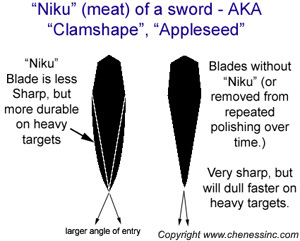 To
address this, the traditional Japanese swords generally has some body built into
it's profile ("niku" or "meat" of the blade). This body is
sometimes referred to as the "appleseed" or "clam" shape.
This shape increases the durability of the blade, but slightly reduces the sharpness
or cutting ability of the blade from the increased angle of entry.
To
address this, the traditional Japanese swords generally has some body built into
it's profile ("niku" or "meat" of the blade). This body is
sometimes referred to as the "appleseed" or "clam" shape.
This shape increases the durability of the blade, but slightly reduces the sharpness
or cutting ability of the blade from the increased angle of entry.